
Love a caftan on Pinterest? How to have it tailored from a photo
Turn a Pinterest caftan into a clear tailoring brief: fabric, sfifa, aakad, lining, quotes and fittings to check with a Moroccan atelier.
Caftanio editorial team ·
Last updated:
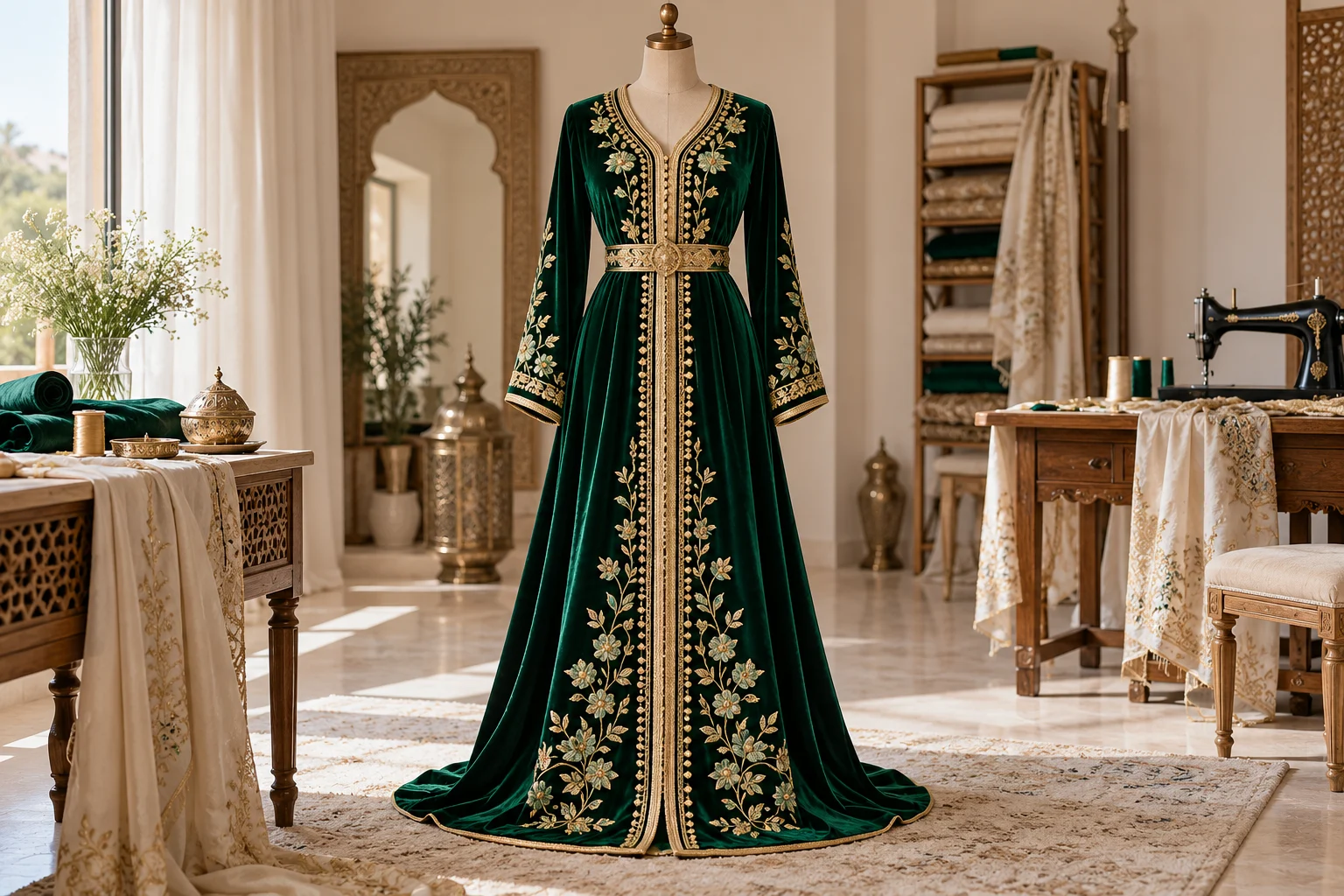
You save a picture of an emerald green caftan, send it to a tailor and ask whether they can make the same one. It feels like a simple request. Yet the photograph shows very little about how the garment is constructed, how heavy it feels or whether its sleeves allow you to move comfortably. A successful commission starts by turning the image into decisions that you and the atelier understand in the same way.
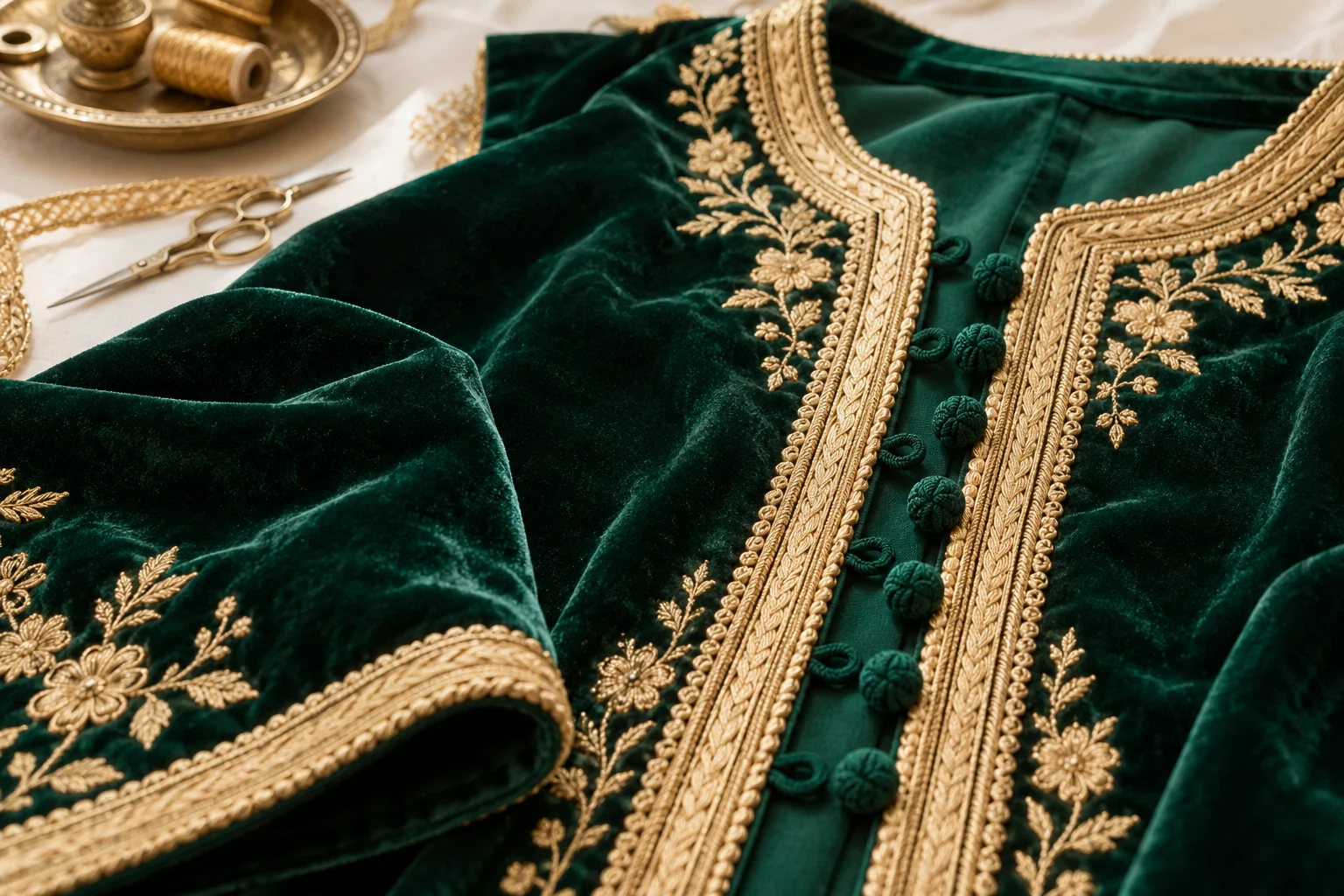
This guide follows an illustrative example: a one-piece Moroccan caftan in emerald velvet, with fine gold sfifa, traditional thread aakad buttons, restrained floral embroidery and a coordinated mdamma belt. Adapt the approach to your own preferences. The illustrations show a design idea; they are not photographs of an available product or evidence of a particular atelier's work.
Before paying a deposit, confirm the cut, actual fabric samples, decorative work, interior finish and fitting schedule. A photograph alone cannot settle those choices.
1. Use the photograph as inspiration
Start by identifying what attracts you to the garment. It might be the deep green, the neckline, the balance of embroidery or the shape created by the belt. Separate those essentials from details you would happily change. A tailor can then suggest an adaptation that suits your measurements and budget without promising an exact result from an incomplete reference.
Gather a front view, a back view if available, sleeve and neckline details and a short video showing movement. If only the front exists, tell the atelier which unseen details need to be proposed. Do not assume the back has the same decoration or that an attractive opening conceals a comfortable fastening.
Keep the original creator's link with your reference. Finding an image on Pinterest does not automatically give permission to republish it. For public posts or a distinctive design you intend to reproduce, discuss the necessary permission with the creator. Prefer your own adaptation and photographs you are entitled to use. The original image should support a conversation about the garment rather than replace that conversation.
2. Write a practical design brief
For our example, the caftan is one main piece, gently shaped at the bust and gradually wider towards the hem. It has long sleeves, a modest V neckline, a central opening and a matching belt. Whether the aakad are functional or decorative must be agreed. These descriptions are decisions to discuss, not a technical cutting pattern.
| Element | What to confirm with the tailor |
|---|---|
| Shape | One-piece caftan, softly shaped with comfortable movement |
| Colour | Emerald green approved on a real sample in daylight |
| Outer fabric | Supple clothing velvet suitable for the season |
| Front | Fine gold sfifa, thread aakad and an agreed fastening |
| Decoration | Small balanced floral motifs with approved placement |
| Interior | Suitable lining, protected seams and an even hem |
| Belt | Coordinated mdamma with a comfortable fastening |
| Schedule | Intermediate fitting, final fitting and delivery date |
Save the agreed brief with the quote. If you change an important feature later, ask whether it affects the cost, fabric quantity or delivery date. Written updates help both sides avoid relying on different versions of a conversation.
3. Choose the actual fabric
Two green velvets can behave very differently. A stiff cloth may create bulk where the reference falls softly; a lighter fabric may struggle to support dense decoration. Ask to see and touch a sample, then look at it in daylight and indoor lighting. A colour sent through a phone camera can be a useful starting point but does not establish an exact match.
Check the drape, weight, pile direction and cleaning instructions. Velvet looks lighter or darker depending on the direction of its surface fibres, so the cutting plan matters. Ask the atelier how it will check the fit before cutting the final cloth and whether a toile or another preliminary fitting is appropriate for the design.
Consider the venue and season as well as the photograph. A velvet outfit may feel uncomfortable during a hot outdoor celebration. Discuss crepe or another lighter alternative if necessary, while accepting that the result will move and reflect light differently. Request an example made in the proposed material rather than judging every option against a photograph of another fabric.
4. Agree on sfifa, aakad and embroidery
Sfifa is the braided trim used along garment edges. Aakad are traditional thread buttons, often paired with loops. In our example, warm gold trim follows the neckline and central opening, while small floral motifs add detail without covering the whole front. Compare the actual trim against the chosen velvet before deciding on its shade and width.
Ask where the buttons will sit, how far apart they will be and whether they close the garment. If they are decorative, identify the real fastening. At a fitting, open and close the functional elements yourself. A beautiful front still needs to be practical when you dress for the event.
Approve the motif size and placement through a sketch or sample. A pattern that looks delicate on a screen can become large across the bust or disappear under the belt. Ask which work will be done by hand, machine or a combination of techniques. Compare the actual sample, consistency and finish rather than assuming that the technique's name guarantees the quality you want.
5. Look inside the caftan
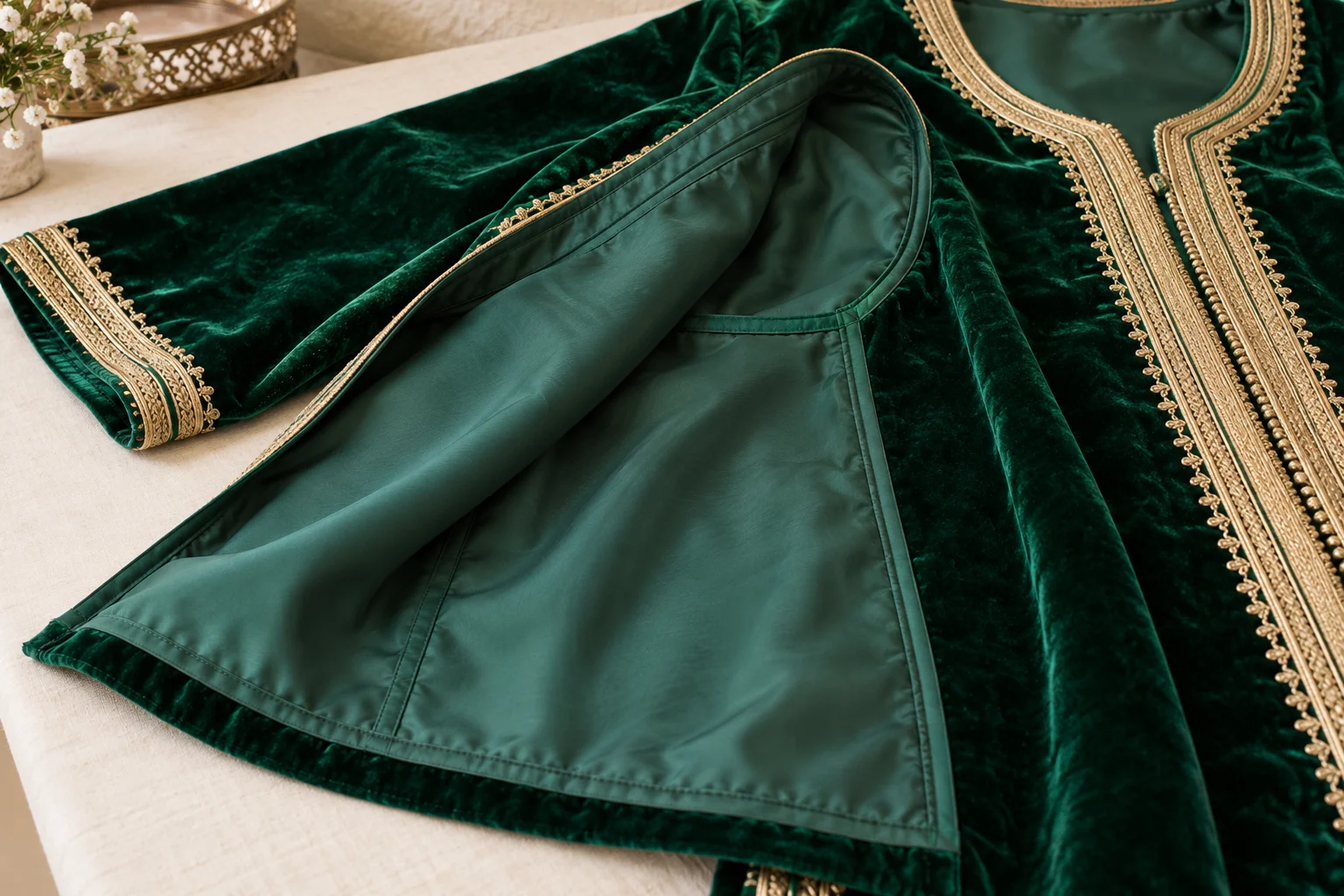
The lining contributes to comfort, movement and how the outer fabric hangs. Discuss a smooth lining suited to the weight of the velvet and the temperature of the event. The material's composition and behaviour matter more than a vague description such as “luxury satin”. Ask to see how the lining and outer cloth work together.
Request an inside view of a garment the atelier has actually finished. Look at the armholes, side seams, embroidery backing and hem. Loose threads should not catch jewellery or rub against the skin. Check that the lining does not pull the outer garment, show beneath the hem or restrict the sleeves when you move.
Clarify any hidden zip, facing or additional fastening. These details affect how easily you can put on the outfit and whether you will need help. The illustrations in this guide explain what to discuss; only examination of the real garment can establish its finish. Bring any concern to the tailor while it can still be addressed during construction.
6. Plan measurements and fittings
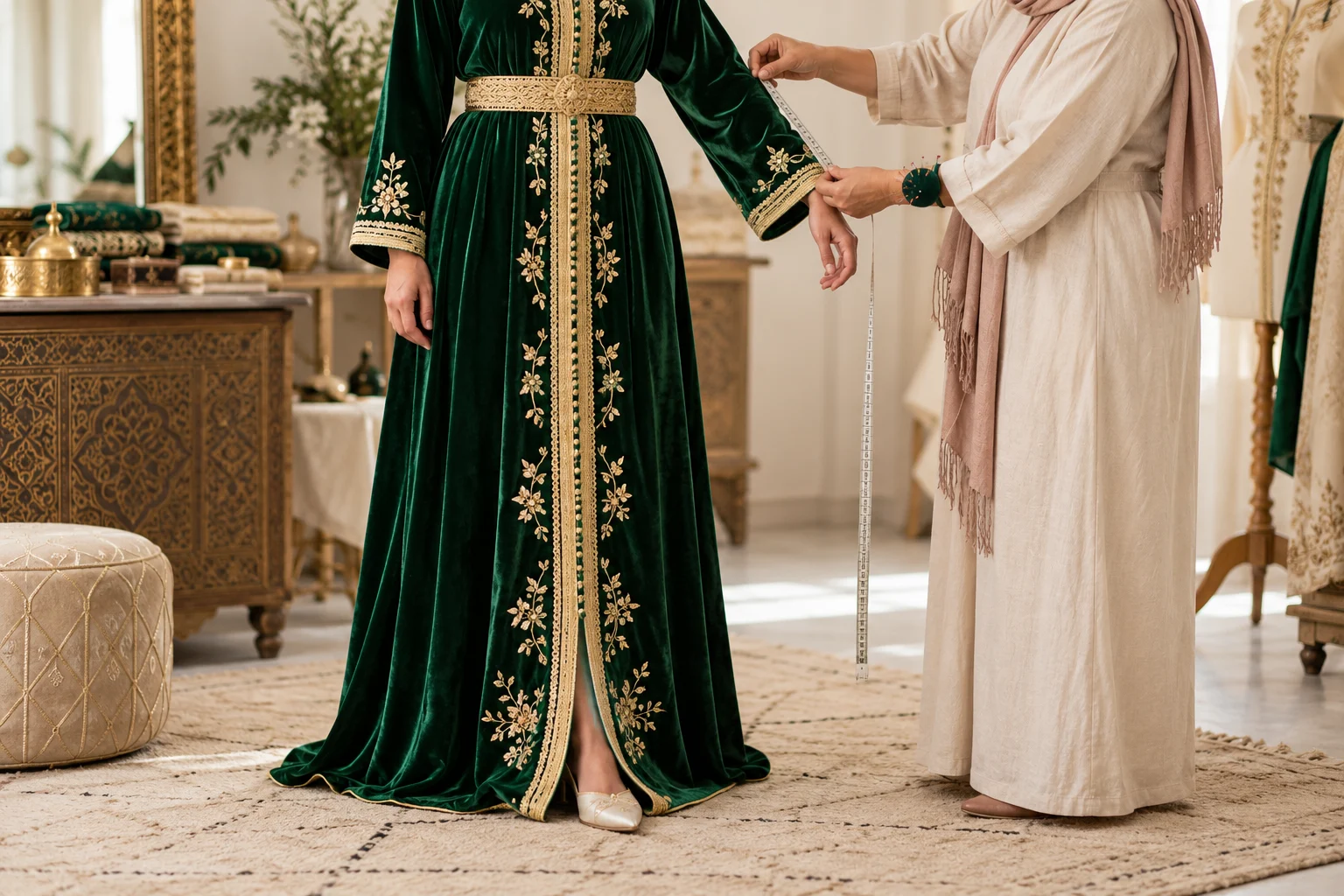
A made-to-measure caftan needs more than a clothing size. The tailor may record shoulders, bust, waist, hips, arm measurements, sleeve length and overall length according to the design. Explain your preferred ease, the undergarments you expect to wear and the height of your ceremony shoes. These choices can change the neckline, waist position and hem.
- Discuss reference images, budget, event date and essential features.
- Approve samples of the outer fabric, lining, trim and threads.
- Confirm the cut through the atelier's proposed pattern or fitting process.
- Agree on embroidery placement before it becomes difficult to alter.
- Attend an intermediate fitting for the shoulders, sleeves and length.
- Complete a final fitting with the belt and ceremony shoes.
Walk, sit down, lift your arms and turn while wearing the outfit. Check that the belt lets you breathe comfortably and that sleeves remain manageable during a meal. Agree on corrections before collection. Our fitting preparation guide covers the practical items to bring and questions to ask.
7. Compare complete quotes
There is no single meaningful price for a custom caftan without understanding its materials and work. Request a written quote covering fabric quantity, lining, sfifa, aakad, embroidery, construction, belt, fittings and alterations. Include transport if relevant and clarify who will buy each material. Ask what happens if an approved colour becomes unavailable.
Compare quotes for equivalent work. One may omit the belt or corrective fitting while another includes them. A higher figure alone does not prove a better finish, and a low initial figure can grow when missing items are added. Look at examples of completed work with a similar fabric and level of detail.
Work backwards from the celebration date to agree on sample approval, construction, fittings, corrections and collection. Leave a margin for adjustments rather than treating the evening before the event as a realistic first fitting. If you are still deciding whether commissioning a garment suits your plans, compare it with renting or buying a caftan before paying a deposit.
To compare a ready-made alternative before commissioning work, browse the caftans offered by Moroccan boutiques and ask the seller about the exact measurements and available alterations.
8. Avoid common reference-photo mistakes
- Relying on a filtered screenshot. Approve the actual fabric colour.
- Requesting an exact copy without discussing the cut. Agree on a personal adaptation and the details that matter.
- Forgetting the back and sleeves. Ask the atelier to explain unseen construction choices.
- Choosing decoration only from a catalogue. Check its size against your garment and belt.
- Ignoring the lining. Inspect the inside and test movement.
- Paying before the scope is clear. Confirm materials, fittings, alterations and dates in writing.
- Collecting without a complete fitting. Try the finished garment with its fastening, shoes and belt.
If an issue appears, describe it precisely and ask which correction is possible. Some changes become much harder after cutting or embroidery. Discuss this before work begins so that expectations remain realistic throughout the commission.
9. A message you can adapt for the atelier
Hello, I would like a one-piece Moroccan caftan inspired by a reference photograph, in emerald velvet with fine gold sfifa, thread aakad, subtle floral embroidery, lining and a matching mdamma. Could we review fabric samples and discuss an adaptation to my measurements? Please confirm what the quote includes, the embroidery techniques, fitting appointments, alterations and delivery date. I can send the references and explain my sleeve and neckline preferences.
A useful reply should identify what is feasible, which choices need approval and what information the tailor still needs. Be cautious about judging an atelier only by a promise of a perfectly identical result before samples or measurements have been reviewed. Compare clear answers and real completed garments.
10. Final fitting and care checklist
- ☐ Fabric colour, trim and decoration match the approved samples.
- ☐ Functional aakad and any concealed fastening close securely.
- ☐ The belt is comfortable and does not hide the main motifs.
- ☐ Sleeves allow sitting, walking and lifting your arms.
- ☐ The lining stays inside and does not pull the garment.
- ☐ The hem works with your ceremony shoes.
- ☐ Remaining corrections and the collection date are recorded.
- ☐ You have the atelier's cleaning and storage instructions.
Ask before applying steam or direct heat to velvet or embroidery. Follow instructions for the actual materials and speak to a suitable cleaner when needed. Store the belt separately if its edges could mark the cloth. Keep the material information and agreed brief with your receipt for future reference.
Frequently asked questions
Can every boutique make a caftan from a photo?
No. A boutique may specialise in ready-to-wear or rentals. Browse the boutique directory, ask whether custom work is offered and inspect examples before choosing an atelier. A listing on Caftanio does not automatically mean bespoke tailoring is available.
Is velvet always the best choice?
Choose it for the drape and conditions you need. Velvet varies in weight and warmth; crepe, silk or brocade create different effects. Discuss the season and decoration with the tailor rather than choosing by a material's reputation alone.
How long does a custom caftan take?
The schedule depends on materials, complexity, fittings and the atelier's workload. Ask for a timetable for your commission, including correction time. A general estimate cannot confirm availability for your event.
Is a caftan the same as a takchita?
In common usage a caftan is usually a main garment, while a takchita often combines layers. Names and constructions vary. Confirm the actual pieces, belt and fastening in the quote and use our outfit selection guide to prepare your shortlist.
Sources and further reading
- GROFIL: sfifa and aakad — trim and thread-button terminology.
- Threads: How to Sew Velvet Like a Pro — fabric characteristics and handling.
- Pinterest: copyright — information about using images.
These references complement a discussion with your chosen atelier. They do not replace approval of the actual samples, fit, finish and written quote.