
Women’s djellaba: styles, fabrics and tips for Eid and every day
Traditional, Ouazzania or modern djellaba: how to choose a women’s djellaba (jellaba), which fabric for which season, what to wear for Eid and how to care for it.
Caftanio editorial team ·
Last updated:
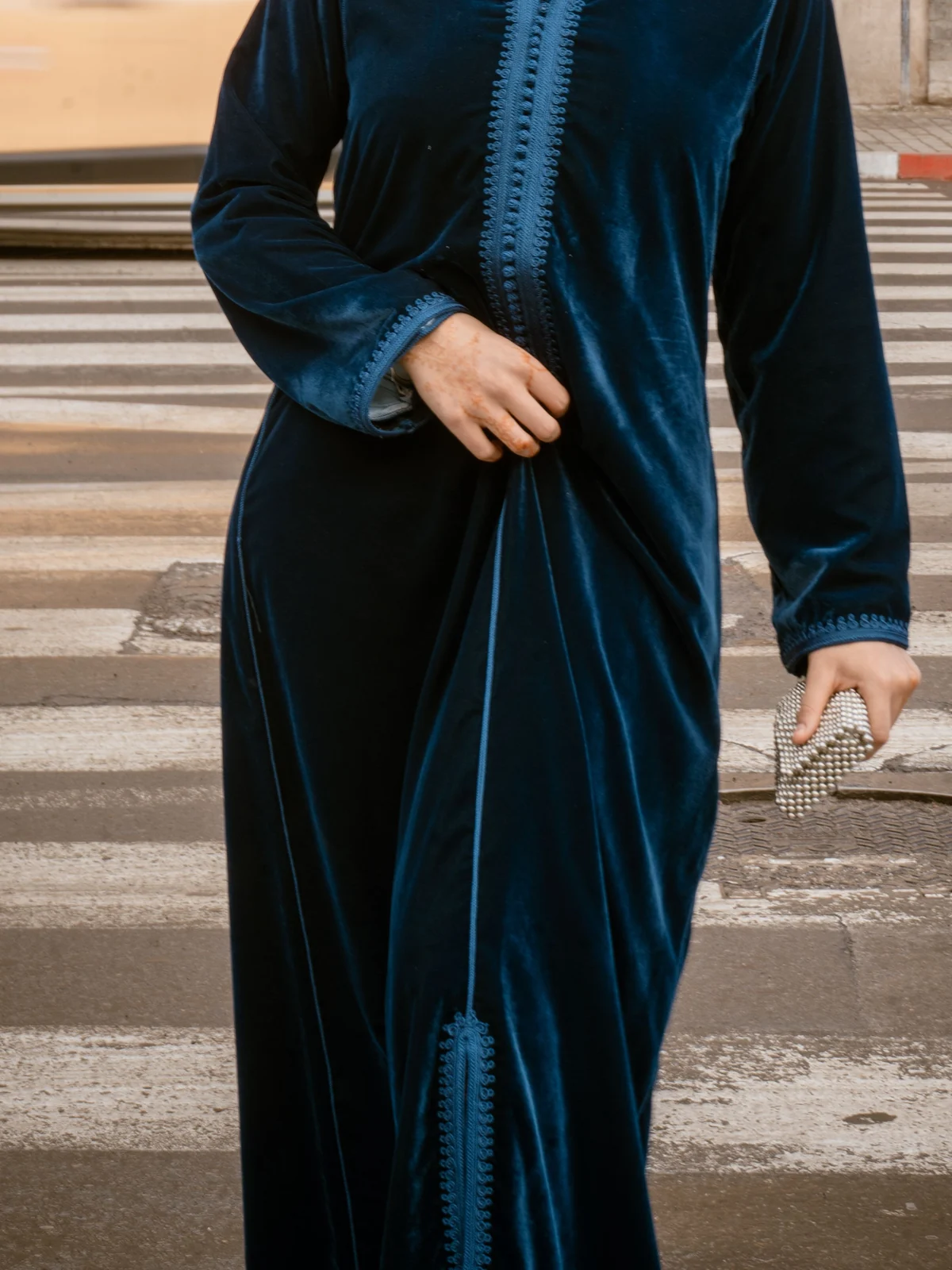
The djellaba (or jellaba) is probably the most worn Moroccan garment. It goes to the market and to Eid prayers, in wool in winter and in light crepe in summer. For women it is both everyday wear and a piece of elegance — embroidered, edged with sfifa, cut from beautiful fabrics.
This guide helps you recognise the main styles, choose the fabric and cut, prepare for Eid and Ramadan, and find your djellaba.
What is a djellaba?
A djellaba is a long, loose robe with long sleeves and a pointed hood, the qob. It is worn over your clothes and closes at the neck with a few aakad, the small braided buttons also found on the caftan. Its edges — neckline, front slit, cuffs — are often trimmed with sfifa.
Men and women both wear it, but the styles differ. Men’s djellabas stay plain, in wool or cotton and neutral colours. The women’s djellaba comes in endless variations: bright or pastel colours, embroidery, randa lace, beads, more fitted cuts, decorative sleeves.
Its strength is versatility. The same woman may own a wool djellaba for winter, a light one for summer and an embroidered one kept for celebrations. It is also modest and practical, slipped on in seconds over house clothes to go out.
The djellaba also holds a special place in family memory: the Eid djellaba a mother buys for her daughter, the wool djellaba passed down, the white djellaba for Friday prayers. It brings together faith, family and elegance.
The main djellaba styles
The traditional djellaba keeps the classic cut: loose, long, pointed hood, sfifa in a matching or contrasting colour. In wool for winter, in cotton or crepe for spring and autumn, it never goes out of style.
The Ouazzania djellaba, hand-woven around the town of Ouazzane, is prized for the fineness of its wool and its drape. It is a sought-after piece, often handed down or given as a gift.
The makhzania djellaba refers to a formal, polished style with particularly careful finishing, worn for important occasions.
The modern djellaba plays with the codes: a closer-fitting cut, flared or butterfly sleeves, a smaller hood or none at all, slits, belts, and fluid fabrics such as crepe, linen or chiffon in bold or pastel colours. Moroccan designers make it both traditional and contemporary.
The festive djellaba, finally, borrows the caftan’s embroidery and ornaments: gold thread, randa, beads. It can replace a caftan for Eid, a small engagement party or a family visit.
Which fabric for which season?
In winter, wool reigns: it protects against cold and rain, especially in the north and the Middle Atlas. Tweed and light woollens offer a finer alternative. Go one size up if you wear jumpers underneath.
In spring and autumn, crepe, jersey and heavier cotton work well: they drape nicely and are easy to wash.
In summer, choose linen, light cotton, viscose or lined chiffon. Avoid thick synthetics. A well-cut summer djellaba stays cool, even in town.
For celebrations, fine crepe, satin or velvet (in winter) show off the embroidery.
Always ask for the exact composition and look at the piece in daylight to judge how sheer it is: a light-coloured djellaba in a fine fabric may need a lining or something worn underneath. And remember: the fabric you love in the shop has to stay comfortable after hours of wear.
Djellaba, gandoura or caftan: which to choose?
All three are long and loose, but they serve different purposes.
The djellaba has a hood and long sleeves; it is the outfit for going out, for prayers, for every day and for Eid.
The gandoura has no hood and short or wide sleeves; it is the outfit for home and summer heat. See our gandoura guide.
The caftan is the ceremonial gown, closed with aakad down the whole front and often belted; it is worn at weddings, henna nights and engagements. See our Moroccan caftan guide.
In practice many women combine them: a gandoura at home on Eid, an embroidered djellaba to go out and visit family, and a caftan for the season’s wedding. Each garment has its place, so you are always dressed right for the moment.
The djellaba for Eid and Ramadan
The djellaba is the outfit par excellence for the big days of the religious year. For Eid prayers and family visits, women choose a new or festive djellaba: a fine fabric, tone-on-tone or gold embroidery, a light colour for the day. White, ivory, beige, pastels and sea green are very popular.
During Ramadan, the djellaba accompanies evening outings, tarawih prayers and visits after iftar. It should be comfortable, quick to put on and made of a fabric that does not crease too much.
The weeks before Eid are the busiest for boutiques and workshops. If you want a specific djellaba, an alteration or a made-to-measure piece, book two to four weeks ahead. Check the djellabas available on Caftanio and book your fitting early.
A small tip: if you are buying an Eid djellaba for your daughter too, you can choose the same colour or embroidery for both — many families love matching outfits in their Eid photos.
Getting the size and cut right
A djellaba is worn loose, but the cut must still be right. Start with the shoulders: the seam should sit where your shoulder is, or the djellaba slides and the hood pulls backwards.
Check the length: most djellabas fall to the ankle. Try it with the shoes you will wear, especially if you walk a lot or climb stairs.
Test the sleeves by raising your arms and reaching out as if to pick something up: they should neither pull nor ride up too high. Check the hood: it should not be so heavy that it drags the neckline.
If you wear the djellaba over other clothes (especially in winter), try it on over a similar layer. If you hesitate between two sizes, ask the boutique for the measurements of the finished piece and compare them with a djellaba you already enjoy wearing. The in-store fitting is free on Caftanio.
And sit down and stand up in it: a good djellaba stays comfortable in movement, not only in front of the mirror.
Finishing: what makes a good djellaba
The sfifa should be even, free of loose threads and well sewn along the neckline, slit and cuffs. Hand-made sfifa shows its density and slight natural irregularities.
The aakad should be sturdy and fasten easily. On a festive djellaba, look closely at the embroidery: it should lie flat, without puckering, and be neat on the reverse.
Check the inside too: overlocked or enclosed seams, a lining (if any) that does not pull, a straight hem. These details make the difference after several seasons of wear and washing.
Finally, the hood should be well set, symmetrical and hang nicely down the back when not worn. A poorly sewn hood distorts the neckline and shows immediately. A djellaba with all these details right will stay with you for years.
Should you buy or rent a djellaba?
For an everyday djellaba, buying is the obvious choice: you will wear it often and wash it regularly. For a heavily worked festive djellaba, renting can make sense if you will only wear it once or twice, as with a caftan.
Some boutiques offer their djellabas both for sale and for rent; each listing says which. Before renting, ask about the deposit, the minimum duration, what happens if it gets stained, and pick-up and return times.
To compare the two options, think in cost per wear, as our rent or buy guide explains. On Caftanio the in-store fitting is free, and the purchase or rental is agreed directly with the boutique.
Caring for your djellaba
A cotton, linen or crepe djellaba can usually be washed at 30 °C, inside out, on a gentle cycle. Dry it on a wide hanger in the shade and iron it on the reverse while slightly damp.
A wool or Ouazzania djellaba needs more care: hand-wash in cold water with a wool detergent, or dry-clean. Do not wring it; dry it flat so it keeps its shape.
An embroidered or beaded djellaba is best taken to a dry cleaner. Never iron directly on the sfifa, embroidery or beads: put a cloth between the iron and the fabric.
For storage, use wide hangers and keep wool djellabas with a moth repellent in a dry place.
Accessorising your djellaba
A djellaba often stands on its own, but a few accessories change its look. A scarf matching the sfifa or embroidery pulls the outfit together; a thin belt defines the waist of a modern djellaba; embroidered babouches or closed shoes in the same colour complete it.
For Eid, a little discreet gold jewellery is enough: the embroidery and fabric already do most of the work. For every day, a simple bag and comfortable shoes. In winter, a wool shawl over the shoulders in the djellaba’s colour adds warmth without weighing down the silhouette.
The idea is to keep the djellaba at the centre: choose one or two accessories, no more, and match their colours to the sfifa.
Where to find a women’s djellaba
Boutiques on Caftanio publish their djellabas with sizes, prices and photos of each piece. Filter by city to find a boutique near you, browse the boutique directory, then book a free fitting.
If you are looking for something lighter for home or summer, see the gandouras too; for a ceremony, the caftans. And to prepare your visit, read our tips to prepare your fitting.
Frequently asked questions about the djellaba
Djellaba or jellaba: which spelling?
Both are correct and name the same robe. In Arabic it is written جلابة; you will also see “djelaba” and “jellabiya”.
Which djellaba should I wear for Eid?
A festive djellaba in a fine fabric, with tone-on-tone or gold embroidery, in a light colour for the day.
Can I wear a djellaba in summer?
Yes, in linen, light cotton or viscose. A loose cut and a light colour keep it comfortable even in strong heat.
What is the difference between a djellaba and a gandoura?
A djellaba has a hood and long sleeves; a gandoura has no hood, is lighter and is mostly worn at home.
How long before Eid should I start?
Two to four weeks ahead, especially for an alteration or a made-to-measure piece.