
The Moroccan caftan: styles, weddings, renting and how to choose
Everything about the Moroccan caftan (kaftan): its traditions, classic and modern styles, how it differs from the takchita, wedding caftans and renting.
Caftanio editorial team ·
Last updated:
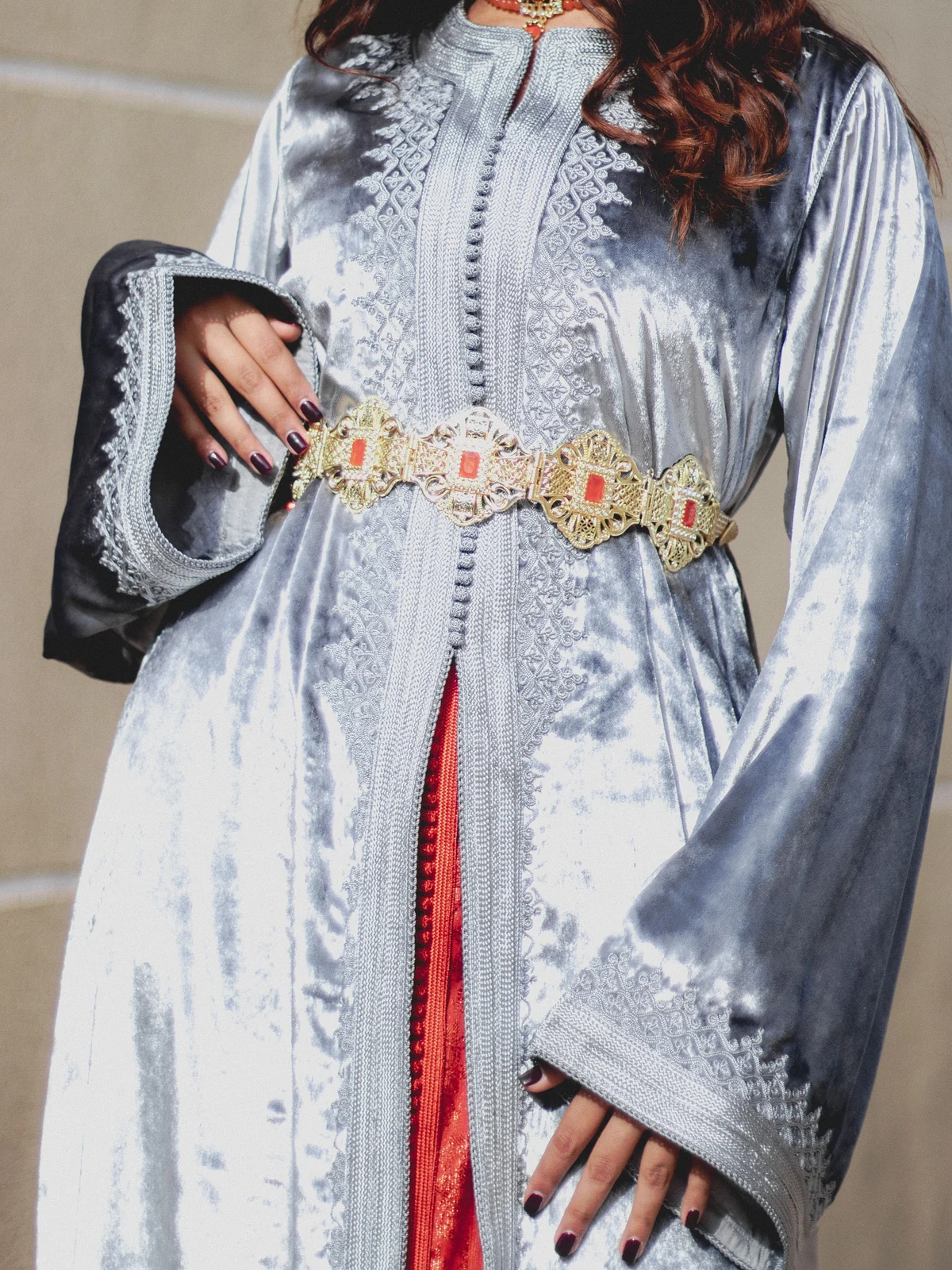
The Moroccan caftan — often spelled kaftan in English — is the outfit for life’s big moments: weddings, engagements, henna nights and Eid. It passes from generation to generation without ever standing still, each season bringing new cuts, colours and ways to wear it.
This guide covers the essentials: what makes a caftan, its main styles, how it differs from the takchita, how to choose a wedding caftan, and how to rent or buy without unpleasant surprises.
What is a Moroccan caftan?
A caftan (also spelled kaftan or qaftan) is a long, one-piece gown that closes down the front with a row of small braided buttons, the aakad. Its edges are trimmed with a hand-sewn braid called sfifa, and the waist is often defined by a belt, the mdamma, embroidered or made of metal.
Its construction looks simple; its value lies in the craftsmanship. The maalem (master artisan) chooses the fabric, designs the embroidery, sets the sfifa and sews the aakad one by one. A fine caftan is as neat inside as outside: clean seams, a lining that does not pull, even embroidery.
Women wear the caftan in every region of Morocco, from the imperial cities to small towns. Each region has its preferred fabrics and motifs, but the idea is the same: a flowing, elegant gown for the most important moments of family life.
The main caftan styles
The Fassi caftan (from Fez) is known for rich fabrics and dense, geometric gold-thread embroidery, tarz fassi. It embodies the classic ceremonial caftan.
The Rbati caftan (from Rabat) favours larger floral motifs and embroidery that covers much of the front and sleeves. It is loved for its stately elegance.
The Tetouani caftan and those of the north have their own cuts and ornaments, often with Andalusian influences.
The modern caftan reinvents the codes: flared or puffed sleeves, capes, cut-outs, fluid fabrics, bold or pastel colours, thin belts. Moroccan designers play with these elements while keeping the handmade finishes — sfifa, aakad, randa — that define the caftan.
Between tradition and modernity there is no right or wrong choice: a classic caftan lasts for years, a modern one follows the mood of the moment. Many women own both, or alternate thanks to rental.
Caftan or takchita: telling them apart
The two are often confused, yet they are built differently.
A caftan is a one-piece gown, worn on its own, with or without a mdamma.
A takchita layers two pieces: an underdress, the tahtiya, and an overdress, the fouqia, often lighter, open or sheer so the first shows through. The mdamma holds them together.
These layers allow plays of colour and texture: plain satin under embroidered chiffon, velvet under lace. The takchita is dressier and a little warmer — it is the signature wedding outfit. The caftan, easier to wear, suits engagements, Eid and evening parties alike.
For a guest the question is mostly practical: a takchita means checking how the two pieces match and whether the fouqia stays in place; a caftan needs fewer adjustments. For a bride, the two often complement each other over the course of the evening.
Fabrics and embroidery: what gives a caftan its value
Velvet makes a majestic, deep winter caftan that shows off gold embroidery. It is warm: keep it for cool evenings.
Crepe drapes well, barely creases and works in every season. Satin catches the light but shows creases. Chiffon and organza are light and often used in layers. Brocade and jacquard carry patterns woven into the cloth.
As for ornaments, sfifa edges the front and sleeves; aakad buttons close the caftan; randa is needle lace set along the edges or as motifs; tarz means embroidery, often in gold or silk thread. Beads, sequins and stones are added on top, sewn by hand or by machine.
Handwork costs more because it takes hours, sometimes weeks. That is no reason to dismiss machine work, but it is a reason to know what you are paying for: ask the boutique what was done by hand, and look at the back of the embroidery.
Choosing a wedding caftan
As a guest, your wedding caftan should be beautiful but also comfortable for a long evening: you will sit, dance, eat and greet people. Choose a fabric suited to the season, a mdamma that is not too tight and sleeves that let you move. Deep tones — emerald, burgundy, midnight blue — remain classics; pastels and bright colours suit summer weddings.
As a bride, the caftan is often one of a series of outfits, sometimes arranged with a negafa (bridal dresser). Check what is already included before booking separately, and coordinate fitting and return dates.
For mothers and close family, a simpler, well-cut caftan with fine finishing is often the best choice: it is easy to wear again at other celebrations.
Whatever your role, try it on with the shoes you will wear, walk, sit down and raise your arms. A caftan that looks perfect on a hanger can become uncomfortable after an hour. Our wedding occasion page gathers the pieces offered for weddings.
A caftan for every occasion
Engagement (khotba): an elegant caftan, less ornate than a wedding outfit, often in soft tones. See the pieces for engagements.
Henna night: green and gold remain the traditional colours. A green caftan or takchita with gold embroidery is a safe choice. See the pieces for henna.
Eid: a light caftan, an embroidered djellaba or a festive gandoura is often enough. Comfort comes first for a day of visits. See the pieces for Eid.
Evening party: a modern, more fluid caftan with a contemporary cut. See the pieces for a party.
Taarof (when two families meet): a neat but simple outfit that puts you at ease.
For each occasion the question is the same: how long will I wear this caftan, and what will I be doing? The answer guides your choice of fabric, ornament weight and cut.
Renting or buying your caftan
Renting lets you wear a ceremonial caftan for a fraction of its price and change style for every celebration. It is often the right choice for a one-off wedding, a heavily worked piece or a style you do not plan to wear again.
Buying makes sense for a caftan you will wear often, for significant alterations, or for a piece you want to keep and pass on.
To compare, think in cost per wear: purchase price + alterations + cleaning, divided by the number of times you will really wear it, against the total cost of renting. Our rent or buy guide walks through the calculation.
On Caftanio, each boutique sets its rental price per day, deposit and minimum duration; you can see available dates and current prices on the caftans page. The in-store fitting is free, and the rental or purchase is then agreed directly with the boutique.
Questions to ask before booking
Before confirming a rental or purchase, get clear answers to these questions:
- The final price: rental or purchase, accessories (mdamma), cleaning, alterations.
- The deposit: how much, and when it is returned.
- The exact piece: can you try on the caftan you will wear, in your size?
- Alterations: which are possible, at what cost, and how long they take.
- Dates: pick-up and return, especially the day after a celebration.
- Damage: what happens if the piece gets stained or torn?
- Cancellation: down payment, changing the date, refunds.
Keep a written record (message, receipt) of the piece, price, dates and conditions. To prepare your appointment, read our tips to prepare your fitting.
Having a caftan made to measure
If you have a precise idea — a colour you cannot find, a particular cut, embroidery you saw in a photo — made-to-measure is a lovely option. It takes time: choosing the fabric, taking measurements, intermediate fittings, finishing.
Prepare clear references (front, back, details), separate what is essential from what can change, and ask for a written quote that specifies fabric, ornaments, fittings and delivery date. Our guide to having a caftan made from a photo covers every step.
On Caftanio, some boutiques accept tailoring requests, and you can also submit a made-to-measure request from the site and receive proposals.
Caring for and storing your caftan
A caftan is rarely cleaned at home. Velvet, gold-thread embroidery and beads do not cope well with water and rubbing: take it to a dry cleaner used to ceremonial outfits, and point out any stain as soon as possible.
To store it, use a wide hanger that supports the shoulders, a breathable fabric cover (never sealed plastic) and a dry place away from light. Keep the mdamma separately, especially a metal one, so it does not mark the fabric. Check the piece a few weeks before each celebration, so there is time for a repair or a press.
A well-kept caftan is passed down from mother to daughter: many families still bring out a grandmother’s caftan for a wedding, sometimes with new sfifa or a modernised cut. Before altering a family piece, ask a maalem what can be changed without damaging the original work.
Choosing the right colour
Colour changes everything about a caftan. Deep tones — emerald, burgundy, midnight blue, plum — are timeless for evening ceremonies and show off gold embroidery. Light and pastel shades — ivory, powder pink, sky blue, sage — suit daytime events and summer weddings. Bright colours — fuchsia, mustard, royal blue — make a statement and photograph beautifully.
Try the colour near your face in daylight, not only under shop lighting. If you want a caftan you can wear often, choose a plain colour with tone-on-tone or light gold embroidery: you can change its look with jewellery and a different belt.
Frequently asked questions about the Moroccan caftan
Kaftan or caftan: which spelling?
Both name the same gown. “Kaftan” is the usual English spelling, “caftan” the French one; in Arabic it is written قفطان.
How far ahead should I book a caftan?
For wedding season (summer) and the weeks before Eid, book your fitting two to four weeks ahead.
Is a caftan always worn with a belt?
No. The mdamma is common, especially for ceremonies, but many modern caftans are worn without a belt or with a thin one.
Can I wear a caftan in summer?
Yes — choose a light fabric (crepe, lined chiffon) and avoid velvet.
What is the difference between a caftan and a djellaba?
A djellaba has a hood and is worn every day and to go out; the hoodless caftan is a ceremonial gown.